Welcome to our comprehensive overview and informational guide on Selling My Structured Settlement Payments. In this detailed article, we provide deep insights, historical context, and practical guidelines about this trending topic. Our editorial board has gathered facts from verified sources to help you understand all aspects of the subject matter. We examine current trends, future developments, and real-world applications to keep you ahead. Whether you are researching for educational purposes, business planning, or general knowledge, this guide offers a solid foundation. Explore the detailed analysis, tabular statistics, and answers to frequently asked questions below to expand your understanding.

A structured settlement is a negotiated financial or insurance arrangement through which a claimant agrees to resolve a personal injury tort claim by receiving part or all of a settlement in the form of periodic payments on an agreed schedule, rather than as a lump sum. As part of the negotiations, a structured settlement may be offered by the defendant or requested by the plaintiff. Ultimately both parties must agree on the terms of settlement. A settlement may allow the parties to a lawsuit to reduce legal and other costs by avoiding trial. Structured settlements are most widely used in the United States, but are also utilized in Canada, England and Australia.
Structured settlements were first utilized in Canada as part of the settlement of birth defect claims arising out of pregnant mothers ingesting Thalidomide. Structured settlements are now used in a wide variety of types of lawsuit settlements such as aviation, construction, auto, medical malpractice and product liability.
You can sell some or all of your structured settlement payments to a factoring company for immediate cash. Although you must first obtain court approval, you have the legal right to cash out your future payments — either in part or in full — to a structured settlement buyer. Depending on the terms of your structured settlement, you may also be able to sell survivor benefits.
Sales of structured settlements begin with a need or want. You want to buy a house or you need to pay off your college loans, for example, but your annuity payments can’t match your wants or needs.
You may wonder, “Can my structured settlement be changed?” It can’t. Once you and the at-fault party reach your terms and a life insurance policy company picks up the annuity, the terms are fixed and finalized. Here is where structured settlement companies, like J.G. Wentworth, come into play.
Before you contact a structured settlement company, though, take a few steps backward. Selling a structured settlement works by taking precautions and doing your research, so start with these steps:
Talk to your lawyer Meet with your attorney from your settlement case and ask, “Can I sell my structured settlement?” You may find you’re in violation of the document’s fine print if you transfer your settlement. If your lawyer gives you the thumbs-up, talk with them about why you want to sell all or a portion of your settlement.
Decide your reason to sell A judge evaluates and rules on every structured settlement transfer — it’s the law. If your reason to sell is that you want a new sports car, versus needing to secure a home, a judge will likely rule the transfer isn’t in your best interest. Judges also look into the purchasing company’s history, the amount you’re receiving and any past requests to sell your settlement.
Find your structured settlement company : Sell your structured settlement, or parts of it, the same way you buy a car. Shop around. You’ll probably receive a better price if you don’t choose the first company that gives you a quote. Make sure your broker agrees to pay any fees.
Wait for your court date: Prepare to wait more than a month to two months before meeting with a judge to approve your proposed structured settlement transfer. If you’re pressed for cash, however, a lot of settlement companies provide small cash advances.
Notarize your agreement: Finalize your transfer agreement and receive your funds so you can move on with your life and plans. If you’re pressed for time or want a notary to meet your schedule, mobile notary services are convenient and available nationwide.
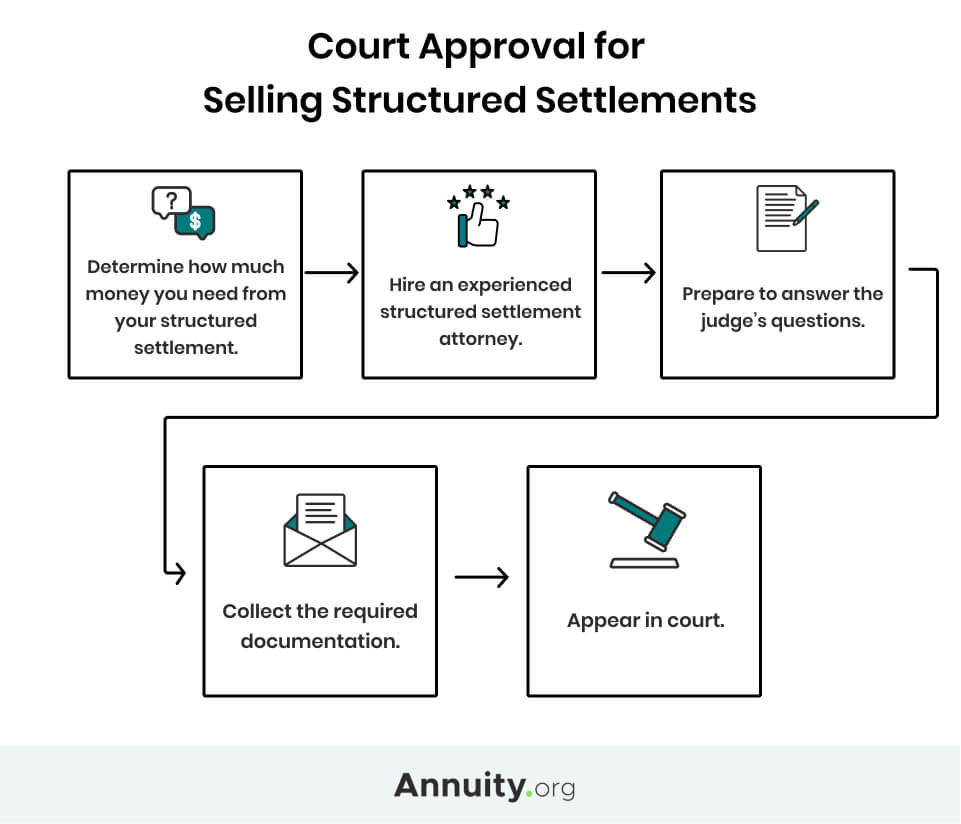
1. Selling your structured settlement allows you to convert its periodic payments into a single lump sum of cash.
2. The amount you receive will be less than the total value of the scheduled payments.
3. The structured settlement buyer’s discount rate — along with its fees — will affect how much money you will receive.
4. Structured settlements are thoroughly regulated through both state and federal laws and selling any structured settlement requires a judge’s approval.

If you are thinking about selling your structured settlement payments, we recommend you enlist the help of a trusted attorney or financial advisor with experience in the structured settlement secondary market. They will help you find a credible factoring company with a history of protecting the long-term interests of its clients.
All structured settlement sales require a judge’s approval. The judge will consider the terms of the sale — whether you’re selling some of your payments, a portion of each payment, or your entire structured settlement — and how the sale will affect your long-term financial situation, including the likelihood that you will suffer financial hardship without the regular payments from your structured settlement.

